.png)
Jan 2026 STEM Project: Building and Testing a Rubber Band–Powered Airplane
Project Theme: Flight, Energy, and Iterative Design
Tools Used: PLAYSTEAM Rubber Band Powered Airplane Kit
Outcome: A professional-grade aero model portfolio ✈️
Why I Started This Project
I’m starting a personal challenge: one hands-on STEM project every month.
The goal isn’t just to build things - it’s to understand why they work, experiment with improvements, and document the learning along the way. For my first project, I wanted something that looked simple on the surface but had real engineering depth underneath.
That’s how I landed on a rubber band–powered airplane.
At first glance, it feels like a toy. But once you start building and flying it, you quickly realize it’s a great way to explore:
Energy storage and transfer
Aerodynamics and lift
Weight distribution
Iterative testing and optimization
What’s Inside the Kit (and Why It Matters)
The PLAYSTEAM airplane kit includes laser-cut wooden parts, a propeller assembly, rubber band motor, and basic instructions. What I liked immediately was that it doesn’t over-engineer the build - you still have to think.
Some early decisions that mattered more than I expected:
Wing alignment and symmetry
How tightly to wind the rubber band
Balancing strength vs. weight
Making sure friction was minimized in the propeller system
Small mistakes here show up fast when the plane either nose-dives… or doesn’t take off at all.
The Physics Behind the Flight
Here’s what’s happening when the plane flies:
Potential EnergyWinding the rubber band stores energy, similar to compressing a spring.
Kinetic EnergyWhen released, that energy spins the propeller, pushing air backward.
Lift vs. DragThe wings are shaped to create lower pressure above and higher pressure below, generating lift - if the speed and angle are right.
StabilityThe tail surfaces help keep the airplane flying straight instead of spinning or stalling.
One of the coolest realizations was how tiny adjustments - millimeters of wing angle or a slightly different wind count - completely changed flight performance.
Testing, Failing, and Improving
My first few test flights were… not great.
One stalled immediately
One climbed sharply and dropped
One veered off like it had its own agenda
Instead of rebuilding from scratch, I treated it like an engineering problem:
Adjusted wing angle
Reduced friction in the propeller shaft
Experimented with different rubber band tension levels
Each test taught me something measurable. By the end, I had a plane that flew longer, straighter, and more consistently.
Final Result

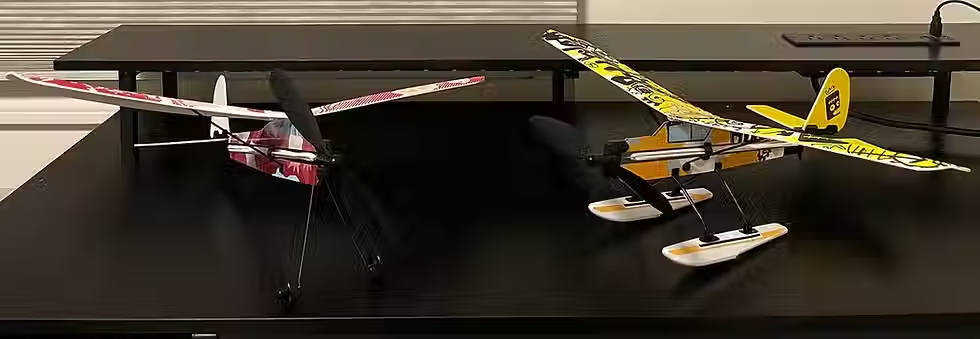
The finished model isn’t just functional - it’s clean, balanced, and display-worthy. More importantly, it represents a full design cycle:
Build
Test
Analyze
Improve
That’s real engineering.
What I Learned
This project reinforced a few big ideas:
Simple systems can teach complex concepts
Engineering is mostly about iteration, not perfection
Physics becomes intuitive when you can see it fail in real time
It also reminded me that hands-on projects make theory stick in a way textbooks alone never can.
What’s Next
This is just Project #1.
Next month’s challenge will explore a different STEM area - possibly electronics, renewable energy, or robotics. The plan is to keep building, documenting, and learning in public.
If you’re a student interested in engineering, I highly recommend starting small and building often. You’ll be surprised how much you learn from something that looks like a toy at first.


Comments